
You’ve probably heard of having a fixed or growth mindset, but mindset isn’t one or the other, it’s a continuum and can change. And mindset isn’t just about how fixed or open we are, there are different types of mindset too.
It’s important to understand our mindset at any one time, so that we can recognise how it might contribute towards our decision-making. It’s especially important to understand, as a leader or manager, when you’re thinking about strategy, growth, change, and how it can impact your decision-making.
In this article, we’ll explore the aspects of growth and fixed mindset, the mindset continuum, and the power of YET. You can even take a free assessment to understand where you are, if you don’t already know.
Why is understanding mindset important?
We believe it’s important, because if we’re not aware where we are, how can we understand how our mindset might impact the way we think, how we perceive opportunities and barriers, and how open or otherwise we are to change and considering different perspectives? It could also affect our decision-making, if we are somewhat risk-averse or have a higher risk tolerance.
You may have seen an image similar to the one below many times before, and the statements made for Fixed and Growth are used to demonstrate the opposing sides of mindset. This is generic way of looking at mindset, however, it does provide a high-level overview of how it can be described on the different sides of the spectrum. Is there a particular side that resonate with you more than the other?
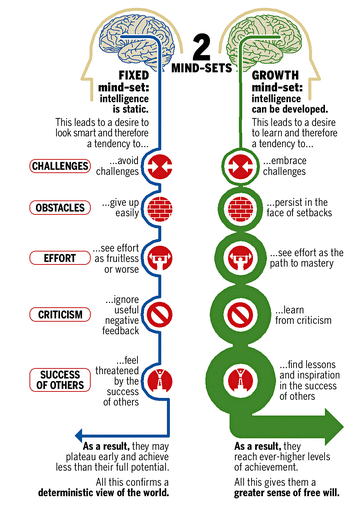
Of course, our mindset isn’t static and it is possible to change, although we do need to be open to this way of thinking, something which is a little more of a challenge.
If you’re in business, how does your mindset affect the way you make decisions? How does it impact you and your team?
Today might be a good day to observe and ask these questions.
We will talk about the Mindset Continuum below, so if you’d like to know where you sit in terms of your mindset, take this FREE ASSESSMENT, which is based on the work of Carol Dweck, researcher and author.
The Mindset Continuum
As we mentioned, you usually see articles talking about mindset as fixed or growth, however, like most things we can look at mindset on a linear scale … a continuum. And remember, one person’s perspective of a growth mindset may seem rather fixed compared to another person’s view.
It probably won’t surprise you to learn that our mindsets are set from an early age and relate to our behaviour, which is often borne out of our relationships with success and failure in both professional and personal contexts, and what has shaped us on our journey through life.
Dweck explains that mindsets are our beliefs. “They’re powerful beliefs, but they’re just something in your mind, and you can change your mind.” Hooray! We can do something about it, we just need to have the will and understand it will take time, especially if these beliefs are deeply rooted in our psyche.

The Power of Yet
As we eluded to earlier, our mindsets are set early in life and relate to experiences, attitudes and beliefs that we have been subjected to – our home, school or work environment; our relationships; and some of the language we have been exposed too.
If we’re not great at something, that’s okay. It doesn’t mean to say that we won’t ever be great at that specific ‘thing’. It means that we’re not great at it YET … all we need to do is practise more. And if we find things easy, it may mean that we’re not stretching ourselves, so we need to give ourselves more challenge.

So if you’re finding something difficult to understand or do, don’t give up, you just haven’t been able to understand or do it YET.
Now if you look at the matter this way, does that put things into a different perspective?
Does it feel a better?
In summary
Yes, we are all somewhere along the mindset continuum. However, if it is more fixed than you’d like, then there’s something you can do about it. The power of YET is an amazing thing, for such a small word it holds a lot of power. As beliefs can be deep-rooted, it will probably take time to work on our thinking patterns, limiting beliefs, and our behaviour to get to a point where we are more open to change.
However, for you personally and professionally, what are the consequences of ignoring the power of YET? Be honest – how does this impact your thinking and decision-making. And if you’re a manager / leader, how does it play-out in your day-to-day role?
There’s more to mindset than just fixed or growth, as you will have gathered. There are different types of mindset, and our mindset can affect how we respond to or resist change, we’ll explore these in future articles.